 ultimate-guide
Benefits of Cat Puzzle Feeders for Indoor Cats
Table of Contents
- Why Indoor Cats Need Puzzle Feeders
- Key Benefits of Cat Puzzle Feeders for Indoor Cats
- Types of Food Puzzles for Cats: Finding the Right Match
- How to Introduce Puzzle Feeders to Cats Successfully
- Frequently Asked Questions
Last Updated: September 5, 2026
Why Indoor Cats Need Puzzle Feeders
Cat puzzle feeders require a cat to solve a simple challenge to access its food, tapping into natural foraging behavior. Indoor cats lack hunting opportunities, which often leads to boredom, weight gain, and stress-related behaviors (avma.org). Puzzle feeders address this core mismatch between a domestic environment and feline instincts.
The real value is behavioral: a cat that works for its meals engages its brain, burns energy, and feels a sense of accomplishment.
Key Benefits of Cat Puzzle Feeders for Indoor Cats
The benefits fall into three categories: physical health, mental stimulation, and behavioral improvement. Physically, they slow down eating and reduce obesity risk; mentally, they provide enrichment that mimics hunting.
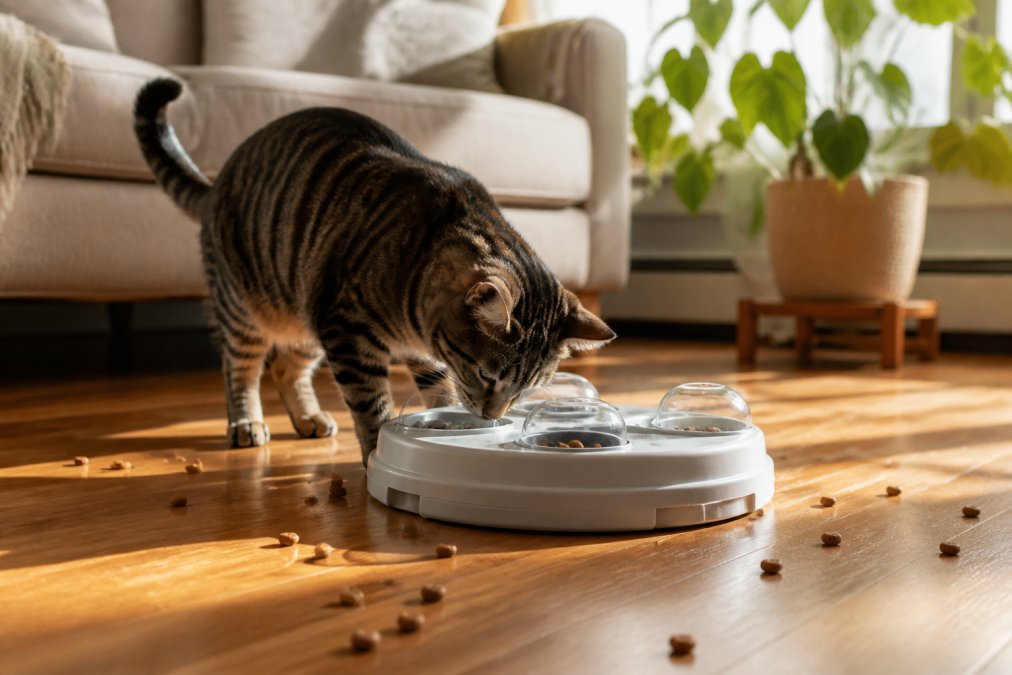
Behaviorally, cats that work for food show reduced anxiety and fewer stress-related behaviors like excessive grooming or hiding, redirecting predatory instinct into productive activity.
Types of Food Puzzles for Cats: Finding the Right Match
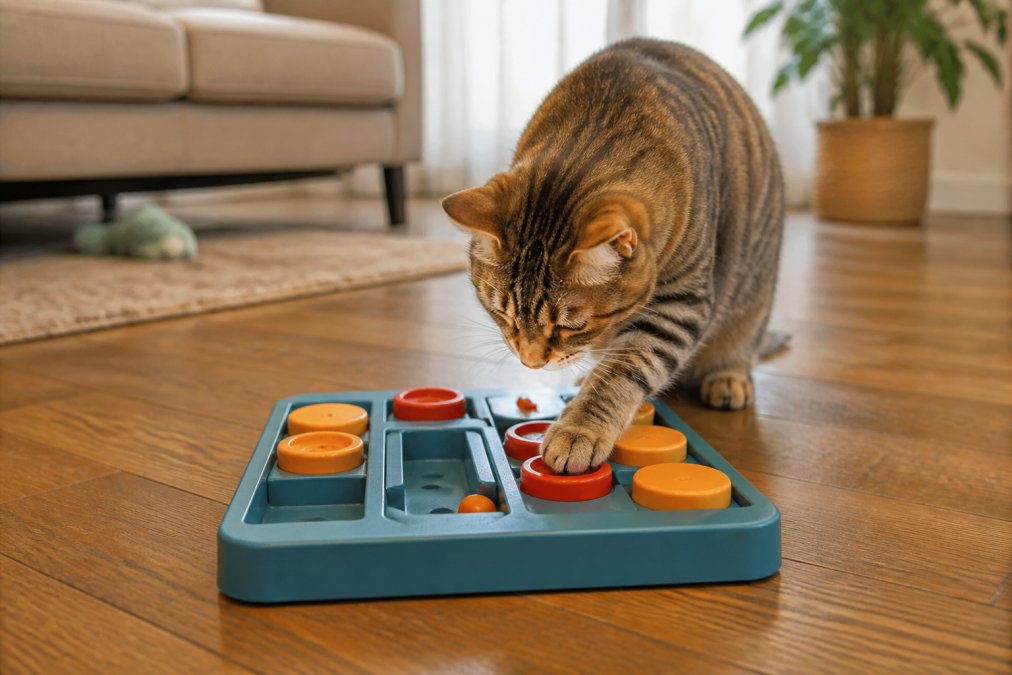
Not every puzzle suits every cat, and mismatching is why many owners give up. Food puzzles fall into two categories: stationary puzzles, where the cat manipulates a fixed object, and mobile feeders, which the cat bats or chases. Stationary options suit cautious cats; mobile feeders appeal to active personalities.
| Puzzle Type | Best For | Example Activity | Cat Personality |
|---|---|---|---|
| Stationary Puzzle | Slow feeding, cautious cats | Sliding panels or lifting flaps to reveal kibble | Methodical, patient |
| Mobile Feeder | High energy, playful cats | Rolling ball that dispenses food as it moves | Active, food-motivated |
| Interactive Dispenser | Problem solvers | Pressing or nudging a component to release treats | Persistent, curious |
A common mistake is starting with a puzzle that is too difficult, which frustrates the cat and reinforces the idea that food puzzles are not worth the effort. The ASPCA's guidance on environmental enrichment for cats recommends starting with easy puzzles that guarantee success before progressing to harder configurations. For a first-time owner, a simple stationary tray with visible food is the right entry point. If your cat is highly food-motivated and playful, a rolling ball feeder adds more movement and engagement.
How to Introduce Puzzle Feeders to Cats Successfully
Introducing a puzzle feeder takes patience, but a structured approach improves success. Start by placing the feeder next to the regular bowl with treats inside. For the first few meals, leave the puzzle partially filled and easy to access.
The introduction typically follows a simple progression:
- Place the empty puzzle near the food bowl for two to three days to build familiarity
- Add a few high-value treats on top and around the puzzle, not inside
- Move to filling the puzzle with a portion of the regular meal, leaving some kibble visible
- Gradually conceal the food so the cat must manipulate the puzzle to eat
- Increase difficulty only after the cat solves the current level consistently
If the cat shows no interest after several attempts, try a different puzzle type. Some cats prefer to paw at objects, while others use their nose or mouth, and the Ohio State University's Indoor Pet Initiative notes that matching the puzzle to the cat's natural manipulation style is key to long-term success. A cat enrichment idea for indoor cats that works well is to rotate between two or three puzzle types so the challenge stays fresh and the cat does not memorize a single solution.
The most common failure is a cat that refuses to engage, which is usually a difficulty problem. Go back to an easier setting, use higher-value treats like cooked chicken, and end each session on a success.
Frequently Asked Questions
Are puzzle feeders good for cats?
Yes, puzzle feeders are good for cats, especially indoor cats. They provide mental stimulation and physical activity that mimic natural hunting behaviors. This helps prevent boredom and the stress-related behaviors that often come with it, like over-grooming or aggression. By making your cat work for their food, you also support healthier eating habits and portion control.
How do puzzle feeders help with cat obesity?
Puzzle feeders help with cat obesity by slowing down eating and adding physical activity to mealtime. The effort required to extract food burns extra calories and extends the meal duration, which promotes satiety. This encourages portion control and helps prevent overeating, a common cause of weight gain in indoor cats.
How do I introduce a puzzle feeder to a cat that has never used one?
Start by placing a few high-value treats near or on the feeder so your cat associates it with positive experiences. For your first few attempts, leave the feeder easy to access, perhaps with treats visible in the easiest compartment. As your cat becomes more confident, gradually increase the difficulty by hiding the food deeper or using more complex puzzle types.
Choosing the right feeder and introducing it patiently can transform your indoor cat's relationship with food, turning a mundane bowl of kibble into a daily ritual of problem-solving and play. At SofttailSupply, we carry a curated selection of interactive feeders and enrichment toys, tested with real pets and backed by fast 24-48 hour shipping and responsive support. Get started with SofttailSupply and give your cat the mental workout it craves.
This article was written using GrandRanker