 how-to
Can Senior Dogs With Mobility Issues Use Ramps?
Table of Contents
- Assessing If a Senior Dog Ramp Is Right for Your Dog
- Dog Ramp vs Stairs: Which Is Safer for Aging Joints?
- How to Train a Dog to Use a Ramp with Reward-Based Steps
- Frequently Asked Questions
Last Updated: October 17, 2026
Assessing If a Senior Dog Ramp Is Right for Your Dog
Yes, can senior dogs with mobility issues use ramps? They can, and many do well once the ramp is properly sized and the dog is trained.
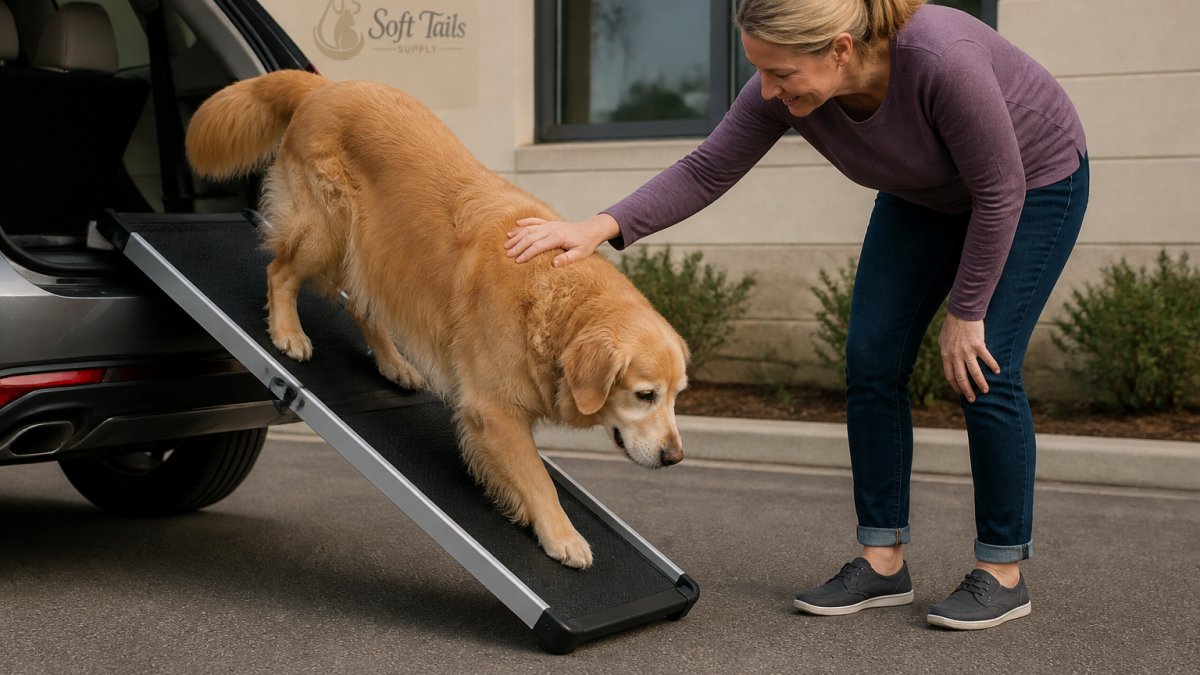
Before buying, answer three questions: can your dog bear weight on all four legs? Is the reluctance pain or fear (pain needs a vet first; fear needs training)? And how high is the jump, a car trunk, bed, and sofa each need a different ramp length.
A ramp helps most when it removes a jump your dog still attempts. If your dog has stopped trying to get on the couch, rebuild confidence with treats and short sessions first.
Dog Ramp vs Stairs: Which Is Safer for Aging Joints?
For most senior dogs, a ramp beats stairs. Stairs load the joints on every stride; a ramp spreads the climb into one smooth, continuous slope. Stairs win for a short rise, a confident stair climber, or tight spaces.
| Factor | Dog Ramp | Dog Stairs |
|---|---|---|
| Joint load | Spread across one slope | Repeated impact per step |
| Best for | Arthritis, hind-leg weakness, short-legged breeds | Short rises, confident climbers |
| Space needed | Longer footprint | Compact |
Traction decides most of this. A smooth ramp is more dangerous than carpeted stairs, so look for a textured, non-slip surface. Inside, our Self-Adhesive Anti-Slip Paw Pads for Dogs add grip on hardwood and tile.

How to Train a Dog to Use a Ramp with Reward-Based Steps
Training is where most ramp purchases fail, and it's also the answer to can senior dogs with mobility issues use ramps. A dog won't use a ramp it doesn't trust, and trust comes from short, rewarded repetitions, not lifting.
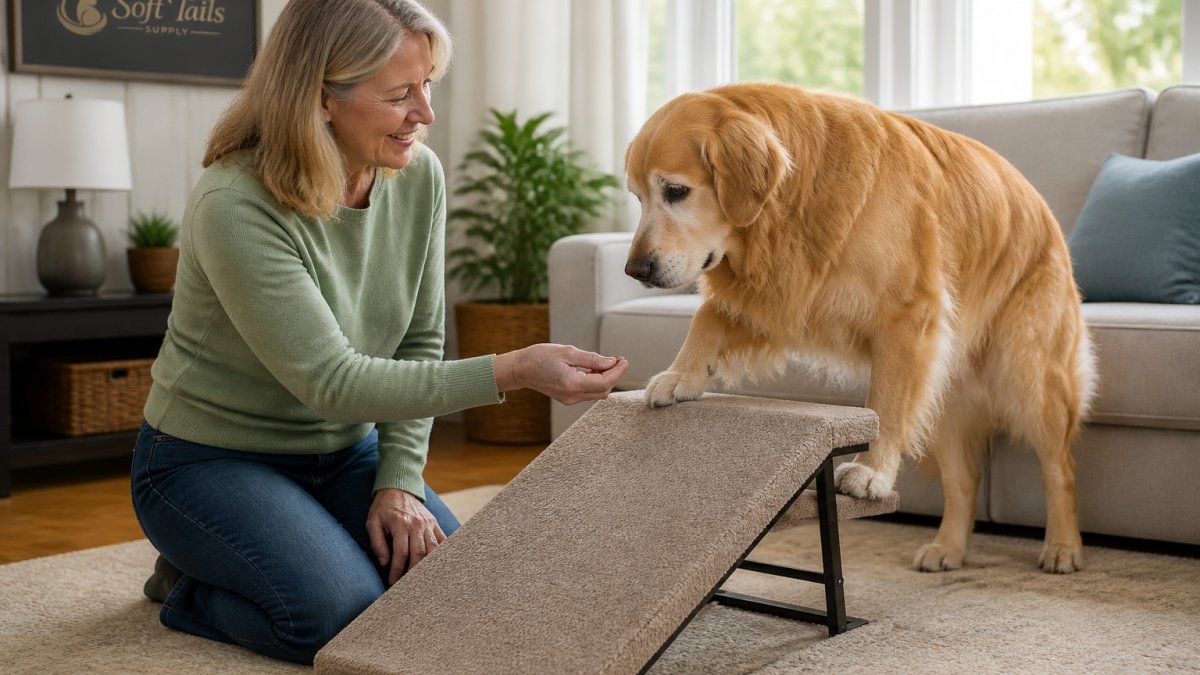
The sequence:
Self-Adhesive Anti-Slip Paw Pads for Dogs →
- Set the ramp flat on the floor and let your dog sniff and walk over it with no height.
- Reward every touch, each paw landing, not just full crossings.
- Raise it one notch at a time, adding height only when your dog crosses calmly.
- Practice the real destination once the flat ramp is boring.
- Use a support harness with handles, then fade the help.
- Keep sessions short, three brief sessions beat one long one.
Expect a week or two for a confident dog, longer for a nervous one. The incline itself is the scary part, not the height, a dog that walks a flat ramp may freeze the moment it tilts, which is why height goes up slowly.
For dogs recovering from a scrape or licking at a hind leg during training, our Protective Hind Leg Sleeves for Dogs give light coverage during supervised sessions.

Measure the rise from floor to surface, then pick a ramp long enough that the incline feels walkable rather than steep.
Frequently Asked Questions
Can a dog with arthritis use a ramp?
Yes, senior dog ramps can help dogs with arthritis by reducing the jump onto furniture or into a vehicle, which lowers joint strain. Choose a gentle incline, usually around 18 to 25 degrees, and a non-slip surface. Watch for painful movement or hesitation during use. If your dog shows signs of joint pain, such as limping or reluctance to climb, talk to your veterinarian before relying on a ramp, since individualized care matters for arthritis management.
How do I train my senior dog to use a ramp?
Start with the ramp flat on the floor and reward your dog for sniffing or stepping on it. Use treats and praise, then slowly raise one end a few inches at a time. Keep sessions short, around five minutes, and never force your dog. Pair the ramp with a support harness if your dog needs extra stability. Once your dog walks up and down confidently at low height, move the ramp to the car or sofa and repeat the reward-based steps.
What angle should a dog ramp be?
Aim for a slope of about 18 to 25 degrees for senior dogs with mobility issues. Steeper ramps increase joint strain and the risk of slipping. To keep the angle gentle, the ramp length needs to be roughly three to four times the height it reaches. For a car seat about 24 inches high, that means a ramp around 72 to 96 inches long. Shorter ramps work for low furniture like sofas or beds.
A senior dog slowing down doesn't have to mean giving up the couch, the car, or the bed. If you're ready to make daily movement easier, SofttailSupply carries practical mobility support, from anti-slip paw pads to protective leg sleeves, with fast 24-48 hour shipping and responsive support if something isn't right. Get started with SofttailSupply and help your dog keep its independence.